Hydraulic systems are the muscle behind countless industrial, construction, and agricultural applications. The hoses that connect these systems are critical components, and selecting the right type can significantly impact performance, safety, and longevity. When faced with the choice between braided wire hose and spiral wire hose, understanding their differences is essential for making the right call.
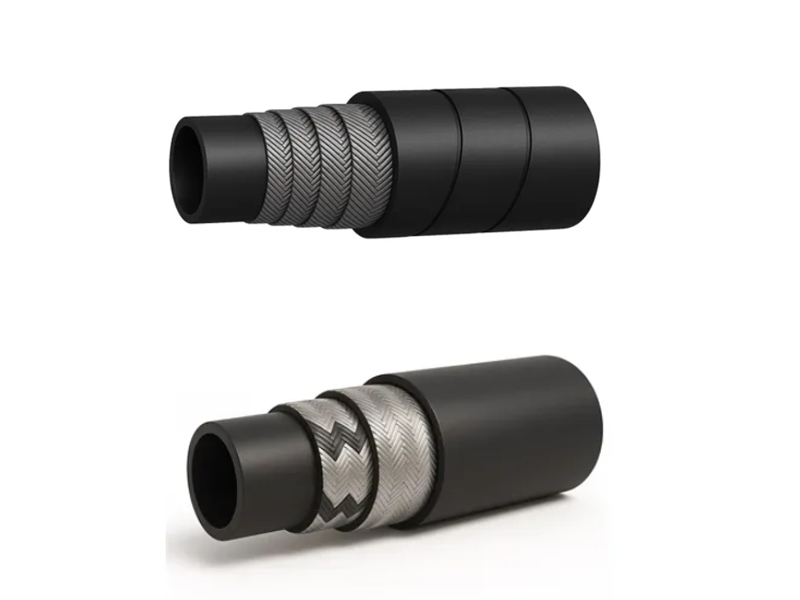
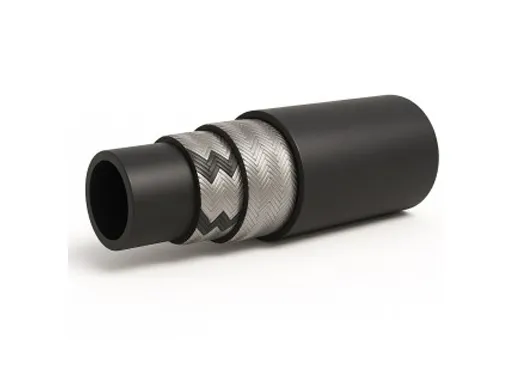
Braided wire hoses typically feature layers of high-tensile steel wire woven together like a fabric or rope around an inner tube. The number of layers determines the working pressure.
Key Characteristics:
Flexibility: Braided hoses are generally more flexible and lighter than spiral hoses, making them easier to route in tight spaces.
Pressure Rating: Suitable for medium to high-pressure applications.
Cost-Effectiveness: Often the more economical choice.
Vibration Resistance: The braided structure offers good resistance to flexing and continuous vibration.
They are the go-to choice for general industrial hydraulics, mobile equipment, and areas where maneuverability is prioritized.
Spiral wire hoses are constructed by wrapping multiple layers of high-tensile steel wire in alternating directions, forming a dense, uniform shield. These layers are precisely wound, often with four or six layers, to handle extreme force.
Key Characteristics:
Pressure Rating: Designed for extremely high and ultra-high-pressure applications.
Robustness: They are stiffer and more robust, offering superior resistance to pressure surges and spikes.
Abrasion Resistance: The thick, spiral layers contribute to greater overall structural integrity.
Spiral hoses are indispensable in heavy-duty environments like large construction equipment, mining operations, and specialized machinery where failure under pressure is not an option.
The decision often comes down to the application's specific needs. If your system involves frequent movement, tight bends, or lower continuous pressure, a braided wire hose is likely the superior choice. Its lightness and flexibility reduce strain on components and simplify installation.
If the application is characterized by constant, extreme high pressure and severe pressure spikes or pulsating forces, you must opt for a spiral wire hose. The construction of the spiral reinforcement is specifically engineered to contain enormous internal forces, ensuring a safer and more reliable operation in the most demanding conditions.
Choosing between braided wire hose and spiral wire hose is a critical engineering decision. Assess the maximum required working pressure, the frequency of pressure surges, the environmental conditions, and the need for flexibility. By matching the hose architecture to the application's demands, you ensure system integrity, minimize downtime, and maximize operational safety.

 English