Hydraulic fittings serve as essential components in hydraulic systems, linking various elements such as pumps, delivery lines, directional control valves, shut-off valves, hydraulic motors, and cylinders to create a complete closed circuit. These accessories enable secure connections, redirection of fluid flow, and distribution of hydraulic fluid. They find widespread application across industries including mechanical equipment, construction machinery, aerospace, and more. In the field of engineering machinery particularly, hydraulic fittings have become indispensable thanks to their compact design, lightweight construction, and dependable performance.
Hydraulic fittings come in numerous varieties because the components being connected at each end often differ in type and specification. The fittings primarily focus on connecting one end to a hydraulic hose while the other end attaches to another hose, a pump, motor, or cylinder. These can be categorized in several ways depending on the classification criteria.
Hydraulic fittings can be grouped according to their connection approach, with the most common categories being flared, welded, insert (or inserting), crimped (or crimping), detachable, and quick-connect (or quick-change) types.
Flared fittings consist of a main body, a sleeve (or bushing), and a nut. They achieve a metal-to-metal seal by compressing the pipe's 37-degree flared end against the conical surface of the fitting body under the nut's pressure. The sleeve helps dampen vibrations and fatigue in the pipeline while preventing the pipe from twisting during tightening. Relying on a hard metal seal, flared fittings perform reliably across a broad temperature range. Their straightforward installation—no welding required—makes them especially popular in medium- to low-pressure hydraulic and pneumatic systems.
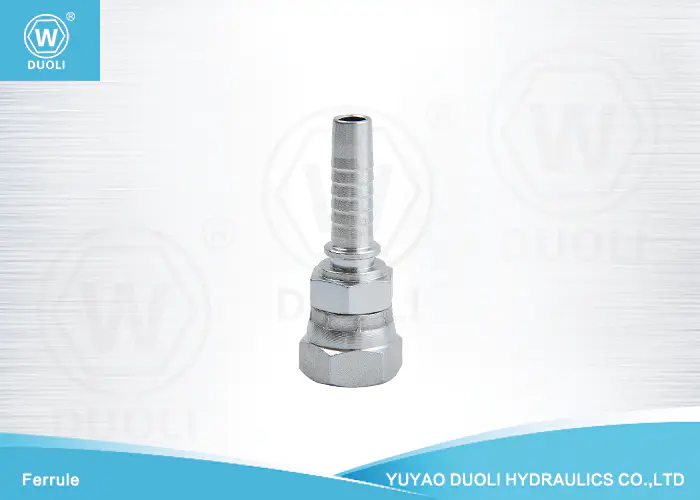
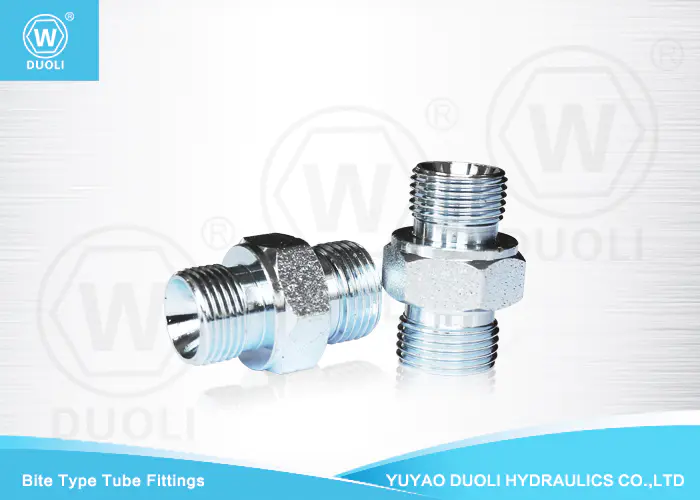
Compression fittings (also known as ferrule fittings) comprise a body, a ferrule, and a nut. Tightening the nut forces the ferrule's front edge to bite into the pipe surface while its outer portion seals against the body's conical area, creating a secure, leak-resistant joint. These fittings are extensively used for connecting pipelines carrying oil, water, steam, and similar media in hydraulic setups. Their simple design, ease of assembly, and weld-free nature make them valuable in sectors such as chemical processing, pharmaceuticals, petroleum, laboratory equipment, and electrical engineering.
Welded hose fittings establish permanent connections through welding and suit systems transporting non-corrosive or mildly corrosive fluids like oil, water, or gas. They see heavy use in industries including oil refining, chemicals, light manufacturing, textiles, defense, metallurgy, aviation, and shipbuilding, as well as in hydraulic lines for various machinery and machine tools.
Quick-connect fittings (also called quick-change or quick-release fittings) allow fast attachment and detachment of fluid or gas lines, making them ideal for hydraulic and pneumatic applications that require frequent changes or maintenance. Their design supports rapid coupling and uncoupling, streamlining tasks like swapping hoses or tools.
Crimp hose fittings feature a sleeve (jacket) and an inner stem (core), tailored specifically for hose connections. Their compact structure enables efficient installations even in confined spaces, minimizing space requirements. A specialized sealing design ensures tight, leak-free performance, enhancing overall system reliability and safety.
Hydraulic hose fittings are also classified based on their thread standards, including NPT tapered threads, JIC 37-degree cone fittings, SAE 45-degree cone fittings, O-ring face seal (ORFS) fittings, JIS fittings, and flange-style connections.
NPT fittings follow the American standard for tapered pipe threads and provide effective sealing for fluid and gas lines through thread interference and deformation. A related variant, NPTF (often used in fuel and hydraulic systems), relies on precise thread engagement for leak-proof performance in fluid power applications.
JIC fittings, featuring a 37-degree cone angle, are specified by SAE standards for high-pressure hydraulic lines. These use straight threads paired with 37-degree conical sealing surfaces on both male and female ends, where the seal forms at the cone interface.
SAE fittings employ a 45-degree cone angle and are typically suited for lower-pressure uses, such as fuel lines or refrigeration systems. Like JIC, they pair straight male threads with 45-degree conical seats on female threads, with sealing occurring at the cone face. Note that some thread sizes overlap with JIC, so careful measurement of the cone angle is needed to distinguish them.
O-ring face seal fittings feature straight threads with an O-ring on the male end and a flat sealing face on the female end. The seal is achieved by compressing the O-ring against the opposing face, providing excellent leak resistance.
BSP fittings adhere to British Standard Pipe threads and are common in hydraulic and pneumatic systems. They include BSPP (parallel threads) and BSPT (tapered threads), each offering distinct sealing characteristics.
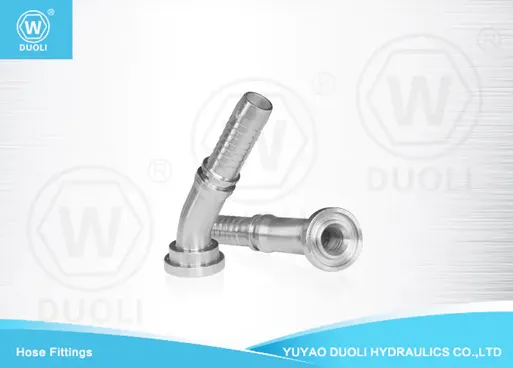
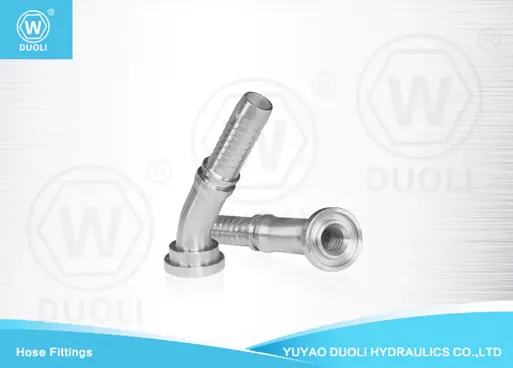
Hydraulic flange fittings create detachable connections using flanges, gaskets, and bolts. By tightening the bolts, they deliver strong, reliable seals and are widely adopted in construction, chemical processing, machinery, and other heavy-duty applications.
JIS fittings conform to Japanese Industrial Standards and are prevalent in industrial automation and fluid control systems, especially in Japan and parts of Asia.
Hydraulic fittings can also be categorized by their sealing mechanism, including cone seals, O-ring seals, flat face seals, spherical seals, combined seals, and adhesive seals.
Cone seals rely on tight contact between conical surfaces to achieve high-integrity sealing. This straightforward, robust method is common in high-pressure hydraulic systems, with typical angles such as 24°, 37°, or 74° suited to different pressure ranges and applications—for instance, 24° for high-pressure hoses and 74° for ultra-high-pressure rigid tubing.
O-ring seals incorporate a rubber O-ring compressed within the fitting to form a reliable barrier. They offer strong resistance to vibration and suit high-pressure environments, though rubber's temperature limitations restrict their use in extreme heat.
Flat face seals create closure between flat mating surfaces and work well in medium- to low-pressure systems. Their simple construction, low production costs, and ease of disassembly make them practical for applications where frequent maintenance is needed, though they are less effective under very high pressures.
Spherical seals use a ball-and-socket or sphere-to-cone interface to provide high-pressure sealing while accommodating minor misalignment or assembly tolerances, often in movable or articulating joints.
Combined seals integrate multiple sealing techniques—such as metal-to-metal paired with elastic elements—to deliver superior performance and address the limitations of individual methods in demanding conditions.
Adhesive seals apply specialized compounds to mating surfaces for a bonded, leak-proof joint. This approach suits static, non-serviceable connections but depends heavily on adhesive quality and can degrade over time due to aging or environmental exposure.
In practice, selecting the right hydraulic fitting depends on the specific application, pressure, temperature, fluid type, and installation requirements. As a manufacturer specializing in hydraulic hoses and fittings, we offer a wide range of options. If you have questions about hydraulic hoses, fittings, or related products, feel free to reach out.


 English