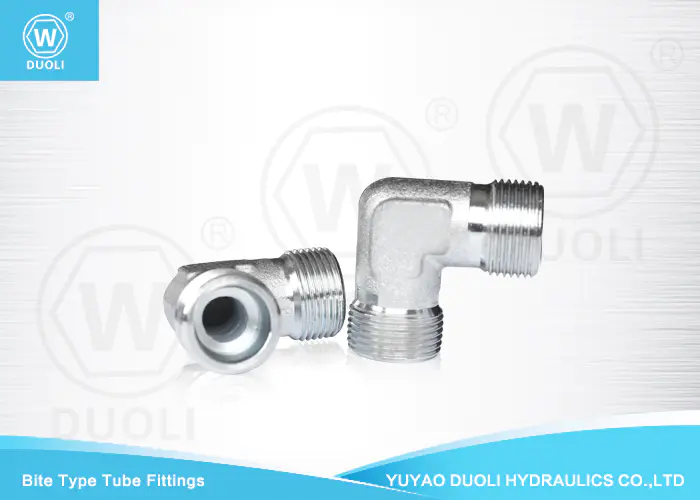
A union tee fitting provides a practical way to divide or combine fluid flow while allowing the connected lines to be assembled and serviced more conveniently. Used in hydraulic, pneumatic, instrumentation, and general fluid-transfer systems, this three-way fitting can simplify piping layouts without requiring multiple separate connectors. However, choosing the right union tee requires more than matching the nominal tube size. Connection type, pressure rating, material, sealing method, and installation conditions all affect performance.
Understanding how a union tee works and how its ports are configured can help engineers select a fitting that provides reliable flow distribution and easier maintenance.
A union tee fitting is a three-port fitting designed to connect three sections of tubing or piping within a single assembly. Its T-shaped body creates a branch connection, allowing fluid to pass through a main line while entering or leaving through a third port.
The defining feature of a union-style design is its connection arrangement. Depending on the specific construction, a union tee can allow components to be disconnected without rotating an entire length of tubing or piping. This can be especially useful in equipment where space is limited or regular maintenance is required.
A tee union fitting may be available with different thread types, tube connections, and port configurations. Some versions use threaded ends, while others are designed for direct tube connection. Reducing configurations can also connect tubes with different outside diameters.
For hydraulic applications, the fitting must be selected according to the actual operating pressure, fluid, temperature, and connection standard. A tee that fits dimensionally may still be unsuitable if its sealing system or pressure rating does not match the application.
The main purpose of a union tee connector is to create a controlled branch in a fluid circuit. In a typical hydraulic system, fluid can travel through the main ports while a third port supplies another actuator, valve, gauge, or auxiliary circuit.
Flow direction depends on the system design. A tee does not inherently determine which port is the inlet or outlet. Instead, the connected components and pressure conditions establish how fluid moves through the fitting.
In a branching application, the available flow is divided between the main and branch circuits according to the downstream resistance and system configuration. In a combining application, two streams can enter separate ports and merge toward the third port.
This makes internal passage geometry important. A properly sized union tee should provide sufficient flow capacity without creating unnecessary pressure loss. The fitting should also be positioned so that connected tubes remain properly supported and are not subjected to excessive bending or mechanical loads.
Union tees are available in several configurations to suit different piping layouts. An equal tee has three ports of the same nominal size, making it appropriate when all connected lines use the same tube diameter. A reducing tee has different port sizes and can connect a main line to a smaller or larger branch.
Another consideration is connection type. A tee union may use threaded ports, compression-style tube connections, or other connection designs depending on the applicable standard. The correct configuration depends on the tubing material, equipment interface, pressure requirements, and maintenance needs.
| Configuration | Typical Application | Key Consideration |
|---|---|---|
| Equal union tee | Three lines of the same size | Matching tube diameter |
| Reducing union tee | Main line with smaller/larger branch | Correct port sizing |
| Threaded tee union | Connection to threaded components | Thread standard and sealing |
| Tube connection tee | Direct tubing connection | Tube OD and connection method |
| Hydraulic union tee | Hydraulic branching circuits | Pressure, fluid and material |
In compact equipment, configuration can have a significant effect on installation efficiency. Choosing the appropriate tee can reduce additional adapters, shorten the overall connection path, and provide easier access during maintenance.
Pressure rating is one of the first specifications to verify when selecting a union tee fitting. The fitting should be rated for at least the maximum working pressure of the system, including pressure fluctuations or pulses that may occur during operation.
The connected components should also be considered. A fitting with a high pressure rating does not increase the pressure capability of a hose, tube, valve, or other component connected to it. The complete fluid path should therefore be evaluated as an assembly.
Material selection depends on the fluid and surrounding environment. Carbon steel is widely used in hydraulic systems where mechanical strength is important, while stainless steel may be preferred when greater corrosion resistance is required. Other materials may be appropriate for specialized fluids or operating environments.
Temperature should be considered alongside pressure because elevated temperatures can affect both fitting materials and sealing elements. The fitting should therefore be selected according to the actual combination of pressure, temperature, fluid, and environmental exposure.
Correct size matching is essential for reliable installation. Tube size is commonly identified by outside diameter, while threaded ports may be specified according to a particular thread standard. These dimensions should not be confused.
For example, two components may appear similar in nominal size while using different thread standards or sealing methods. A BSP connection, metric connection, and other thread systems require their corresponding mating components.
When selecting a union tee connector, verify the tube outside diameter, thread type, pitch where applicable, port size, and sealing arrangement. For reducing tees, confirm the dimensions of all three ports rather than checking only the main line.
The connection standard should also match the equipment already installed. Duoli's hydraulic fitting range includes different connection systems and configurations, allowing fittings to be selected according to specific hydraulic circuit requirements.
Incorrect matching can cause cross-threading, poor sealing, excessive assembly force, or restricted flow. These problems may not always be visible during initial installation, which makes dimensional verification particularly important before components are assembled.
Correct installation helps the union tee fitting maintain its designed sealing and pressure performance. Before assembly, inspect the fitting, tubes, threads, and sealing surfaces for contamination, burrs, corrosion, or mechanical damage.
The tubing should be cut and prepared according to the requirements of the selected connection system. It should enter the fitting without excessive force or misalignment. Threaded connections should engage smoothly rather than being forced into position.
Common installation checks include:
Confirm connection specifications: Verify tube size, thread standard, sealing method, and fitting configuration.
Inspect components: Check threads, sealing surfaces, O-rings, washers, and tube ends before assembly.
Maintain alignment: Prevent the tubing from placing side loads or bending stress on the fitting.
Use correct tightening: Follow the fitting manufacturer's recommended assembly procedure instead of relying on excessive torque.
Check the finished connection: Inspect for leakage after assembly under appropriate operating conditions.
Over-tightening is a common mistake because additional torque does not necessarily improve sealing. It may instead damage threads, distort sealing elements, or place unnecessary stress on the fitting body.
For systems exposed to vibration, tubing should also be properly supported. Repeated movement or external loading can eventually affect a connection that was initially assembled correctly.
A union tee fitting is used to connect three fluid lines and create a branch or combining point within a piping or hydraulic system. It can also simplify assembly and maintenance depending on its union-style construction.
Both provide three-way connections, but a union-style configuration may make disconnection and servicing easier without requiring extensive movement of connected tubing. The exact design depends on the fitting manufacturer and connection standard.
Start with the outside diameter of each connected tube and the required port size. Then verify the thread standard, sealing method, flow requirements, and pressure rating. Reducing tees require all three port dimensions to be checked.
It can be used when the specific fitting is rated for the system's maximum working pressure, temperature, and fluid. The complete assembly must also include compatible tubing, hoses, and connections.
Common causes include incorrect sizing, damaged sealing elements, contaminated threads or sealing surfaces, poor alignment, improper tightening, and excessive mechanical loading from connected tubing.
A properly selected union tee fitting can simplify fluid routing while providing an efficient point for branching or combining flow. Reliable performance depends on matching the fitting configuration with the tube size, thread standard, pressure, temperature, fluid, and sealing method. Whether the application requires a tee union fitting, union tee connector, reducing tee, or another hydraulic configuration, careful specification and correct installation are essential. Duoli's range of hydraulic fittings and adapters provides connection solutions for different hydraulic and fluid-transfer requirements, helping engineers select components according to the actual needs of their systems.


 English